Thursday, October 3, 2013

Update on Estonia - final chapter

We continued on to our accommodation in Kuressaare, the prettiest of Estonia's island towns. Unfortunately our hosts Toomas and Marike had unexpectedly been called to Sweden on a family matter but Neeme (pronounced Nayma), their friend and house resident, was there to welcome us. The first night we had dinner of a magnificent fish soup prepared by Marike, accompanied by the obligatory shots of icy vodka. The next day Neeme arrived at our guest house with some bottles of local Pihtla farmhouse ale (7.6%) that he sourced from the brewer and some smoked fish. He explained that the proper way to eat the fish is with your fingers, so we proceeded to devour the fish washed down with the local ale (and later with some 80% proof local vodka that I found in the town). Needless to say we all had an early night !!!!!
Our accommodation in Kuressaare.
Our smoked fish, Pihtla ale and vodka feast. We spent time touring the old town centre, Kuressaare Castle (dating from the mid-14th century and the best preserved medieval fortress in Estonia) and visiting Maree's relatives and family friends.
Views of Saaremaa. We managed to safely return to Tallinn (much to Robert's surprise) after driving just over 1,500 kms around Estonia. We negotiated driving on the 'wrong' side of the road alright but our Mazda 6 automatic had dodgy electrics and if it refused to start we had to manually switch through all the gears in the hope that the problem would be fixed - this made for interesting times, especially our last fuel stop in Tallinn when we did not think the car would re-start.
Last views of Tallinn Old Town and our hotel coffee shop. Whilst in Kuressaare, Neeme gave us a guided tour of his hydraulic cylinder manufacturing business called Vatta Metall; it was a very impressive operation. He also showed us a woodworking business next door where two replacement doors for the Kuressaare Castle were being produced - once completed each massive door would require 10 men to move it.

Wednesday, October 2, 2013

Update on Estonia continued again

We departed from Parnu and headed for the island of Saaremaa, Estonia's largest island. We took a ferry from the mainland port of Virtsu to Kuivastu on the island of Muhu which is connected to Saaremaa by a road bridge and on the way to Kuressaare, the capital, we detoured to view the windmills at Angla. Saaremaa once boasted hundreds of windmills but the five square towers that stand here are among the last that survive in working order and have become symbolic of the island.
On the ferry to Saaremaa.
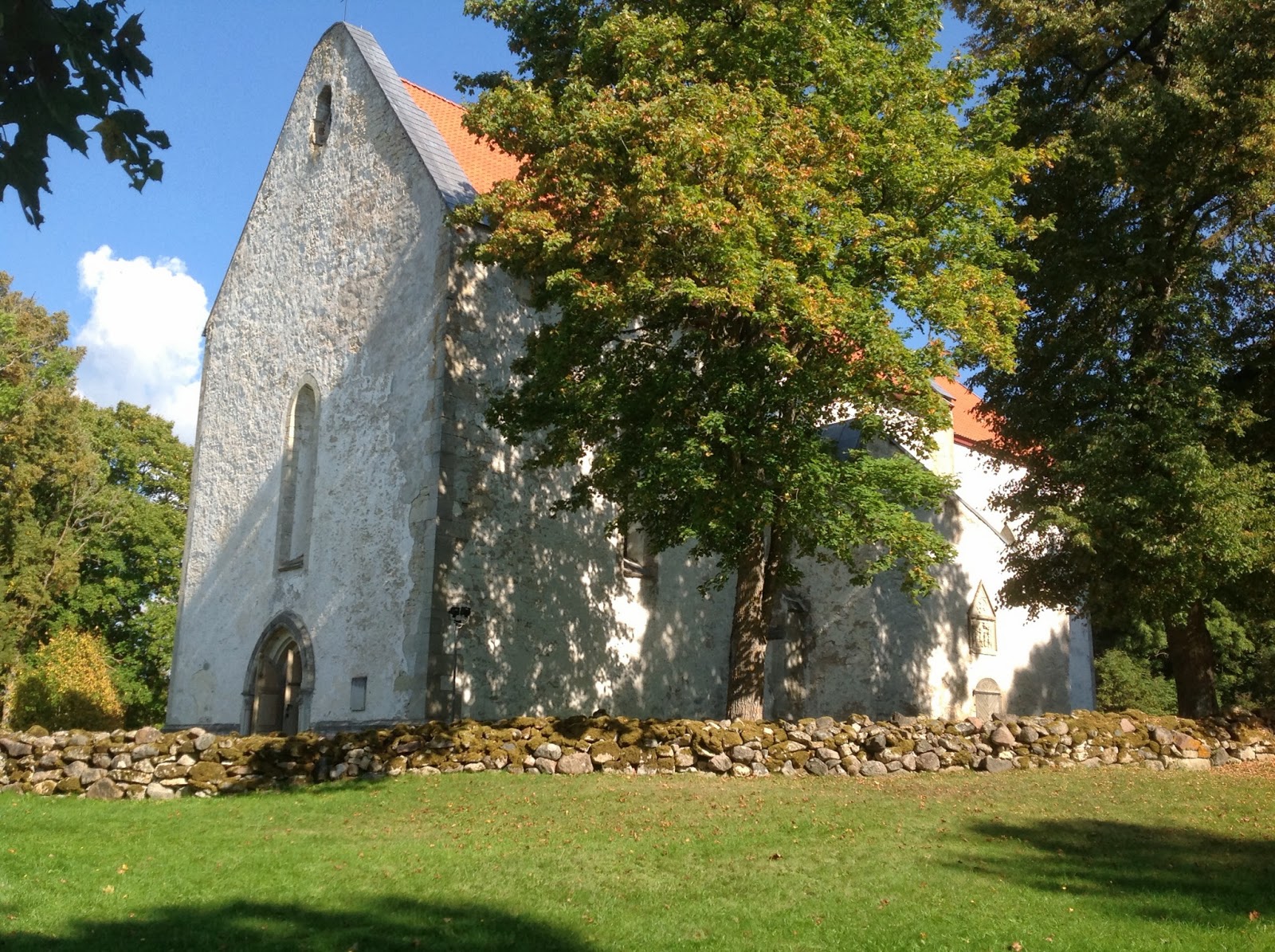
Windmills at Angla. We also visited St Catherine's Church, the 15th-century church of Karja parish, the smallest place of worship on Saaremaa. It's wall frescoes show pagan influences and it's carved roof pillars were the work of masons from all over the Baltic region.
St Catherine's Church, Karja, Saaremaa.

Update on Estonia continued

We departed from Tartu and headed for Parnu via Viljandi. Enroute we skirted the shore of Lake Vortsjarv, Estonia's second-biggest lake. At its deepest it is only 6m deep and has a surface area of 270 sq kms.
Views of Lake Vortsjarv. On arrival in Viljandi we had lunch in a local pub and then toured the ruins of a 13th-century castle built by the Livonian Order. Viljandi is a peaceful market town at the heart of one of Estonia's most fertile agricultural areas.
Views of Viljandi. We continued on to Parnu, Estonia's summer capital on the shores of the Gulf of Riga. With the assistance of the local tourist information office we located a hotel for the night and then decided to see the famed beaches. The beaches were a little walk from our hotel and as we climbed the boardwalk over the sand dunes we missed the sign saying ladies beach and advising of nudity - we couldn't understand the strange looks in our direction by women leaving the beach until we reached the top of the dunes and could see the beach. We made a hasty retreat and went to another part of the beach.
Views of Parnu.

Tuesday, October 1, 2013

Update on Estonia

This update is backtracking to catch up on details of our travels around Estonia. We departed from Saka on the Gulf of Finland to travel to Tartu, the second largest city in Estonia, but the largest in terms of student population due to Tartu University founded in 1632. During our journey we stopped at a local museum in Iisaku which gave us an insight into the lives of rural Estonians up to 150 years ago. We continued down the shore of Lake Peipsi, the largest body of water in Estonia and the fourth largest in Europe. We stopped for lunch at Mustvee in a local pub which was preferable to eating at one of the many stalls lining the shore of Lake Peipsi selling smoked fish.
Shore of Lake Peipsi at Mustvee. We continued on to Tartu and found our accommodation with little trouble thanks to our GPS and settled in before touring the city. We found it to be small enough to discover on foot and a very attractive place with its university and many small cafés and cellar bars.
Our guest house accommodation in Tartu, Tampere Maja, the Old Town dwelling is one of the oldest buildings in the city.
Tartu University and nearby mural.
Town Hall Square in the Old Town with the Kissing Students fountain. The first night we went to dinner at the Pussirohukelder (Gunpowder Cellar) the world's highest pub that is a former gunpowder vault that was carved into a downtown hillside in the mid-18th Century - the cellar also had a tasty house red beer that can be ordered by the litre.
The Gunpowder Cellar from the outside. The following day we had a tour of the A. Le Coq Brewery. It was a VERY detailed tour which lasted over 2 hours and I thought it would never end (so I could have a taste of the finished brew!!). I must admit it was a very good tour, but at one stage we were 95 metres above the ground walking on see-through walkways and for one not particularly fond of heights, I was petrified!!!! The brewery produces 65 million litres of beer each year along with many varieties of flavoured mineral water and other soft drinks.
Views at A. Le Coq Brewery, Turtu, Estonia. We also visited the KGB Cells Museum, housed in what was the regional KGB headquarters in the 1940's and 1950's. Apart from the lock-ups themselves, the museum has extensive exhibits on deportations, life in the gulags and Estonian resistance movements.
The KGB Cells Museum, housed in the basement of Turtu's infamous 'Grey House'. Apart from the history we did enjoy Tartu with its vibrant student population; we did have a forgettable meal at a Russian restaurant on our last night but followed with a great night at Moku, the smallest pub in Tartu located in a cellar. I had my first draught Newcastle Brown Ale since my early travelling days in London over 30 years ago and it tasted great.